
Contents
The biggest risk in ecommerce growth in 2026 is not that ad costs are rising. It is that most brands depend on one channel — and one algorithm — for most of their revenue. When Meta tweaks Advantage+, when Google rolls out a new Performance Max default, or when an AI overview changes how product queries get answered, single-channel businesses feel it inside a week.
This guide is the 2026 case for diversifying paid spend, the channels that actually compound together, and the 60-30-10 budget framework we use with SOLID clients.
Diversifying ad spend in a nutshell
- Single-channel dependency is the largest risk in ecommerce. When an algorithm shifts, single-channel revenue can drop overnight.
- Channels compound, they do not substitute. Meta + Google + email + Amazon together usually outperform any one channel run alone, even at the same total spend.
- Channel ROAS benchmarks vary widely: Google Ads averages ~2× to 3× ROAS, Meta sits at ~2.87× all-industry / 3.7× ecommerce, TikTok lands around 2×, and email tops them all at $36 to $72 per $1 spent.
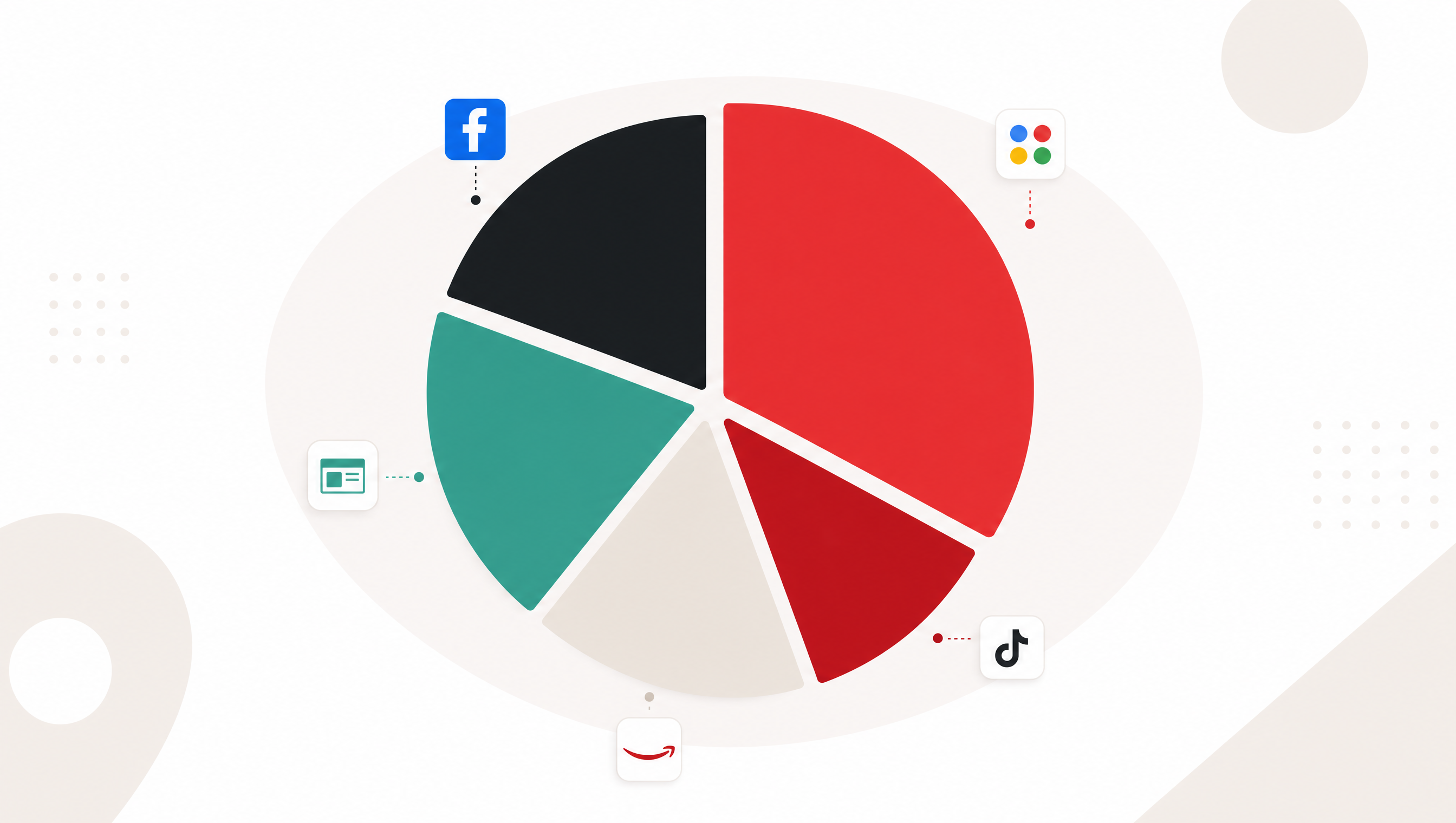
- Use the 60-30-10 budget framework: 60% on proven channels, 30% on growth bets, 10% on experiments.
- AI search reshaped top of funnel. Diversifying into AEO, content, and PR is now as important as diversifying paid channels.
Why single-channel dependence is a 2026 problem
Five reasons brands are getting hit harder when they rely on one channel:
- AI delivery consolidates decisions. Advantage+ and Performance Max removed targeting and bidding control. When the platform changes its model, your account changes whether you wanted it to or not.
- Attribution is noisier than ever. Last-click ROAS in Ads Manager overstates Meta’s contribution by 20% to 40% on accounts without strong server-side signal. A single channel reading your numbers wrong shapes every budget decision.
- Privacy changes keep coming. iOS, browser cookie deprecation, consent mode defaults — every privacy shift hits some channels harder than others.
- AI search shifted top-of-funnel discovery. ChatGPT, Perplexity, and AI Overviews now sit between search and product pages. Single-channel acquisition strategies that assumed Google or Meta would always be primary discovery surfaces are exposed.
- Customer acquisition cost keeps rising. When CACs go up on the channel you depend on, there is nowhere to absorb the change. Brands with diversified channels can rebalance toward whichever is most efficient that month.
What “diversification” actually means in 2026
Diversification is not “run ads on more platforms.” It is a coordinated system where:
- Each channel has a clear job (acquisition, retargeting, retention, defense).
- Spend rebalances based on actual contribution, not just platform ROAS.
- Channels feed each other (Customer Match, custom audiences, content amplification).
- Measurement is non-platform (warehouse, post-purchase surveys, MMM).
We build engagements around this system at our Google Ads agency, Meta ads agency, and cross-border marketing services.
The channels worth diversifying into in 2026
Meta (Facebook + Instagram)
Still the foundation of most paid mixes. Strong full-funnel coverage, mature AI delivery, and the only channel where shopping is genuinely native.
- Best at: acquisition + retargeting, full-funnel.
- 2026 ROAS: ~2.87× all-industry median, 3.7× ecommerce median.
- Best paired with: email, Google, Amazon.
Google Ads (Search + Shopping + PMax)
The intent channel. Captures demand that already exists.
- Best at: branded defense, high-intent search, Shopping, YouTube remarketing.
- 2026 ROI: ~$2 returned per $1 spent at the median, optimized accounts hitting 4× to 8×.
- Best paired with: Meta (top-of-funnel), email (retention).
TikTok Ads
Top-of-funnel discovery engine. Best for visual ecommerce, lifestyle, beauty, supplements.
- Best at: cold acquisition with strong creative, awareness, younger demographics.
- 2026 ROAS: typically lower than Meta in raw numbers (~2×) but high incremental value when properly measured.
- Best paired with: Meta retargeting, organic UGC.
Amazon Ads + Amazon as a channel
For physical product brands, often the highest-ROI channel and the most overlooked diversification move.
- Best at: capturing in-marketplace demand, defending against competitors.
- 2026 dynamics: Sponsored Products, Sponsored Brands, and DSP all matter for serious sellers.
- Best paired with: off-Amazon traffic from Meta and Google to Amazon listings. See our Amazon ads agency.
Email and CRM
The highest-ROI channel in ecommerce, full stop. $36 to $72 returned per $1 spent.
- Best at: retention, repeat purchase, lifecycle, win-back.
- 2026 dynamics: flows drive ~41% of email revenue from only ~5% of sends.
- Best paired with: every paid channel — Customer Match exclusions and lookalike seeds. Full playbook in email marketing for ecommerce.
SEO, AEO, GEO
The free traffic channel that compounds. AI search optimization is now as important as classic SEO.
- Best at: long-term, lower-CAC traffic, AI search visibility.
- 2026 dynamic: AI overviews and ChatGPT now sit in front of Google for many product queries. Brands optimized for AEO get cited; brands not optimized do not.
- See our SEO, GEO, and AEO agency and AI engine optimization guide.
LinkedIn (B2B only)
For B2B with deal sizes above ~$10k and longer sales cycles.
- Best at: ABM, demand gen with content, lead nurture.
- Best paired with: content + retargeting via Meta and Google for branded search defense.
Programmatic, podcast, OOH
For brands above ~$1M monthly ad spend. Marginal channels that often outperform expectations on incremental contribution but only matter once core channels are scaled.
The 60-30-10 budget framework
The framework we use to allocate diversified ad spend:
- 60% on proven channels with known CAC, acceptable payback, and predictable ROAS. These are your acquisition workhorses.
- 30% on growth opportunities — channels or campaign types showing signal but not yet fully optimized. Test budget that lets you scale into them when efficiency holds.
- 10% on experiments — new platforms, new formats, new markets. Most of these fail. The ones that work become next quarter’s 30% bucket.
The framework keeps you investing in stability while compounding optionality. Re-baseline every 90 days based on what actually performed.
| Tier | Share | Examples (ecommerce) |
|---|---|---|
| Proven | 60% | Meta, Google Ads, email, established Amazon |
| Growth | 30% | TikTok, AEO content, LinkedIn (B2B), new market expansion |
| Experiment | 10% | Podcast, programmatic, new ad formats, AI-search-driven content |
Want a fresh look at your channel mix? We will benchmark your current spend, ROAS, and blended CAC against current 2026 standards and tell you where the diversification gaps are.
How channels compound
The point of diversification is not just risk reduction. It is that channels make each other work better.
Meta + Google. Meta builds awareness; Google captures the branded search that results. Together, blended CAC drops 15% to 30% versus running either alone.
Paid + email. Customer Match exclusions stop you paying Meta to convert existing customers. Lookalikes from VIP segments seed acquisition with high-LTV signal. Detail in email marketing for ecommerce.
Paid + Amazon. Off-Amazon traffic from Meta and Google to Amazon listings often returns higher ROAS than the same traffic to your own store, especially for impulse-buy products.
Paid + AEO. AI overviews and ChatGPT cite content. When your brand is the cited source, you get traffic that arrives pre-trusted. Worth treating as a discoverability moat, not a side project.
Cross-border + email. Localized email flows convert dramatically better than translated newsletters. See our cross-border playbook.
OneEarPod combined Meta, Google, email, and cross-border execution to hit 10× revenue across 7 markets. The point was not Meta, it was the integration.
What measurement looks like with a diversified mix
Single-channel measurement breaks the moment you diversify. The minimum 2026 stack:
- Blended CAC and blended ROAS across all paid spend, not channel-by-channel.
- New-customer ROAS vs total ROAS to spot retargeting inflation.
- Contribution margin after ad spend, not gross revenue.
- Post-purchase surveys (“How did you hear about us?”) to cross-check platform attribution.
- Incrementality testing (geo holdouts, conversion lift) once per quarter.
- Lightweight MMM above ~€100k monthly spend.
The most expensive mistake we see in diversified accounts is judging each channel by its own platform’s last-click ROAS. You end up over-investing in retargeting-heavy channels and under-investing in upper-funnel channels that drive incremental demand.
Common diversification mistakes
- Spreading too thin too fast. Five channels at $2k each almost always underperforms two channels at $5k each. Diversification has a floor.
- Treating channels as substitutes. “We moved budget from Meta to TikTok” usually drops blended ROAS. They serve different jobs.
- No measurement layer. Without blended attribution and incrementality, the wrong channel gets credit and the right channel gets cut.
- Forgetting email and SEO. They are not flashy, but they compound the cheapest. Brands that ignore them keep paying full price for traffic.
- Localizing by translation, not by market. Cross-border diversification fails when “expansion” is just running the same campaigns in a new language. See cross-border marketing agency.
Frequently asked questions
When should I start diversifying away from one channel?
Once your primary channel sits above 60% of revenue or above $20k per month in spend, the algorithm risk gets meaningful. Start with a second channel that complements (e.g. add Google if you are Meta-heavy), not one that competes for the same audience.
How much should I allocate to my second channel when starting?
10% to 20% of total ad spend for the first 60 to 90 days, then rebalance based on actual contribution. Going much higher too fast usually underfunds learning and produces a weak read.
Should I diversify across platforms or across campaign types within a platform?
Both, but platform diversification matters more in 2026. Algorithm risk is the bigger threat than format risk.
Is TikTok worth running alongside Meta?
For most consumer ecommerce, supplements, beauty, and lifestyle brands: yes, once Meta is working. For B2B, regulated categories, or brands without strong UGC: usually no, at least not first.
How does AI search affect channel diversification?
It makes top-of-funnel diversification more important. Brands cited in AI overviews get traffic that bypasses Google and Meta entirely. Add AEO content work to the mix before competitors do.
When does a single-channel strategy still make sense?
Almost never above $1M ARR. Below that, focus on doing one channel really well before adding complexity. The threshold for “you should diversify” is when one channel is already working profitably and scale is starting to plateau.
The bottom line
Diversification in 2026 is not a luxury. It is the cost of running an ecommerce or B2B brand in an AI-led, privacy-constrained, multi-search environment. The brands compounding revenue quarter after quarter are the ones running coordinated mixes across paid, email, organic, and marketplace — with measurement that respects how the channels actually work together.
Want a candid look at your channel mix? Book a free strategy call. We will benchmark your current spend against 2026 standards and outline where diversification adds the most growth in the next 90 days.