
Contents
Eligible businesses in Europe and the Middle East can now run ChatGPT Ads through Ads Manager. OpenAI opened self-service access on 31 August 2026. You can create campaigns, set a budget and pay for an ad inside ChatGPT.
ChatGPT Ads in brief
- Your ad appears below a ChatGPT answer, with an ad label.
- The conversation helps determine which ads are shown.
- Buying options include payment per click or per 1,000 impressions.
- You can track clicks and spend; conversion reporting requires tracking setup.
Where ChatGPT Ads are available
Germany, France, Belgium and Switzerland are among the supported advertiser countries. Eligibility depends on the registered country of the company buying and paying for the ads. The UAE and Saudi Arabia are not on the current self-service list. This list tells you who can open an account, rather than every country where users will see ads.
How ChatGPT Ads are shown
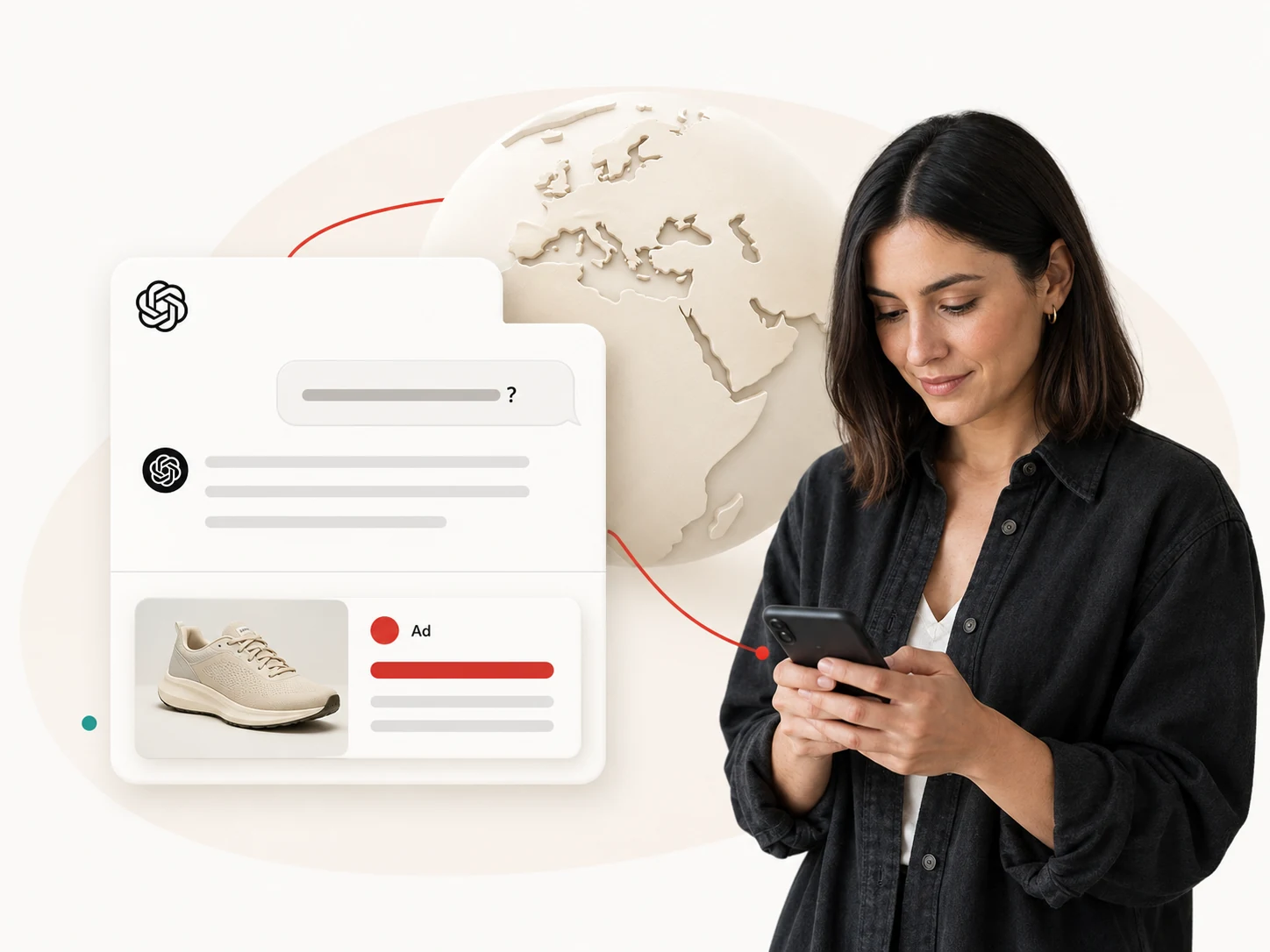
ChatGPT Ads appear below an answer. The ad includes your company name and logo, an image, a headline, a short description and a link to your website.
In our example below, someone asks which headphones to use for work. ChatGPT gives advice, then a headphone ad appears underneath. The answer and the paid placement are separate.

OpenAI matches ads using the conversation, your ad copy, your landing page and other relevance signals. Advertisers can suggest relevant topics through context hints. These are not exact-match keywords and do not guarantee an ad will appear for a particular question.
You set the campaign budget and bids. Buying options include cost per click (CPC) and cost per 1,000 impressions (CPM). Add tracking to measure whether those clicks turn into leads or sales.
How ChatGPT Ads compare with Search, Meta and YouTube
Take the same product: headphones for work.
| Channel | What the customer is doing | What your ad should say or show |
|---|---|---|
| Google Search | Searching “headphones for work” | Call quality, price and a link to the headphones |
| ChatGPT Ads | Asking which headphones suit a shared office | Why this pair fits: clear calls and noise cancellation |
| Meta feeds and Reels | Scrolling Instagram or Facebook | A quick demonstration that makes them stop scrolling |
| YouTube video ads | Watching a video | The headphones in use, with a reason to keep watching |
Like Google Search ads, ChatGPT Ads can reach people already researching a purchase. A conversation can add details across several messages: budget, working environment, features they care about. Google also matches meaning and context, rather than relying only on the exact words someone types.
With Meta ads and YouTube video ads, people are usually there for the content. Your creative has to earn their attention before it can sell. These channels can still drive purchases: Meta uses activity and interests to personalize ads, and YouTube campaigns support conversion goals.
All four need a good offer, a relevant landing page and conversion tracking. Compare cost per qualified lead or sale. A cheaper click is only useful if it brings customers.
What ChatGPT Ads change for search advertisers
Until now, much of the work on ChatGPT visibility focused on getting your brand mentioned through SEO, GEO and AEO. Ads add a second option: pay for a placement, even when your brand isn’t mentioned in the answer. Payment doesn’t buy a recommendation or change ChatGPT’s response.
That gives search advertisers another place to test a budget. If ChatGPT brings qualified leads or sales at a competitive cost, it can earn spend alongside Google. Being new is not enough.
Start with one product or customer problem, a matching landing page and a capped test budget. The early advantage is finding out what sells before your competitors do. Our ChatGPT Ads service covers campaign setup, custom product feeds and conversion tracking. We’ll cover targeting settings and campaign structure in follow-up posts.